

- Orcabay
- Last updated: 7h April 2026
- Reading time: 6 min
CLOB vs AMM vs RFQ: How Crypto Liquidity Mechanisms Work

What they are, how they work, and why it matters for your execution.
Every trade you make goes through a liquidity mechanism. That mechanism determines your spread, your slippage, your order size fulfillment, your final price, and who you trade against. Every mechanism creates different incentives for the actors around your trade — market makers, institutions, pools, and retail all behave differently depending on the rules of the game.
There are three dominant models in crypto today: the Central Limit Order Book (CLOB), the Automated Market Maker (AMM), and Request for Quote (RFQ). Understanding the difference is understanding where value leaks — or stays in your pocket.
What is a Central Limit Order Book (CLOB)?
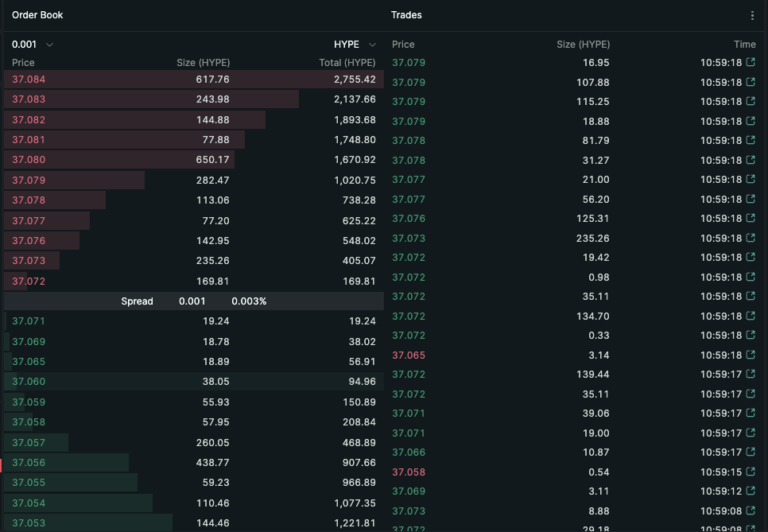
A Central Limit Order Book (CLOB) is the most common liquidity mechanism in both traditional finance and crypto. Market makers, LPs, and traders post resting bids and asks into a public book. NYSE, Coinbase, Kraken, Binance and a majority of other CEXs operate on this model — and on-chain, Hyperliquid brings CLOB infrastructure to DeFi.
Two roles define the CLOB:
- Post a limit order and you provide liquidity (Maker);
- Hit a market order and you consume liquidity (Taker).
The full order book is publicly visible at all times, giving traders complete transparency into available liquidity and price depth.
Pros
- Full transparency (full order book visible)
- Tight spreads in liquid markets
- Minimal slippage on limit orders
- Proven, battle-tested infrastructure
Cons
- High spread / slippage on illiquid assets
- Liquidity fragmentation (same asset split across venues, each book thinner)
- MMs lock idle capital in resting orders 24/7
- Partial fills on large orders
- Higher infrastructure complexity — difficult to run on-chain
What is an Automated Market Maker (AMM)?
An Automated Market Maker (AMM) replaces the order book with a smart contract that holds a pool of assets and prices trades algorithmically. There are no market makers, no resting orders — just a pool and a formula. Uniswap, Curve, and Bancorhttps://bancor.network/ are the most widely used AMMs in DeFi.
Traders swap directly against the pool. LPs deposit assets to provide liquidity and earn yield on trading fees. Arbitrageurs monitor the pool continuously and trade against it whenever prices drift from fair value on other venues — this is what keeps AMM prices aligned with the broader market.
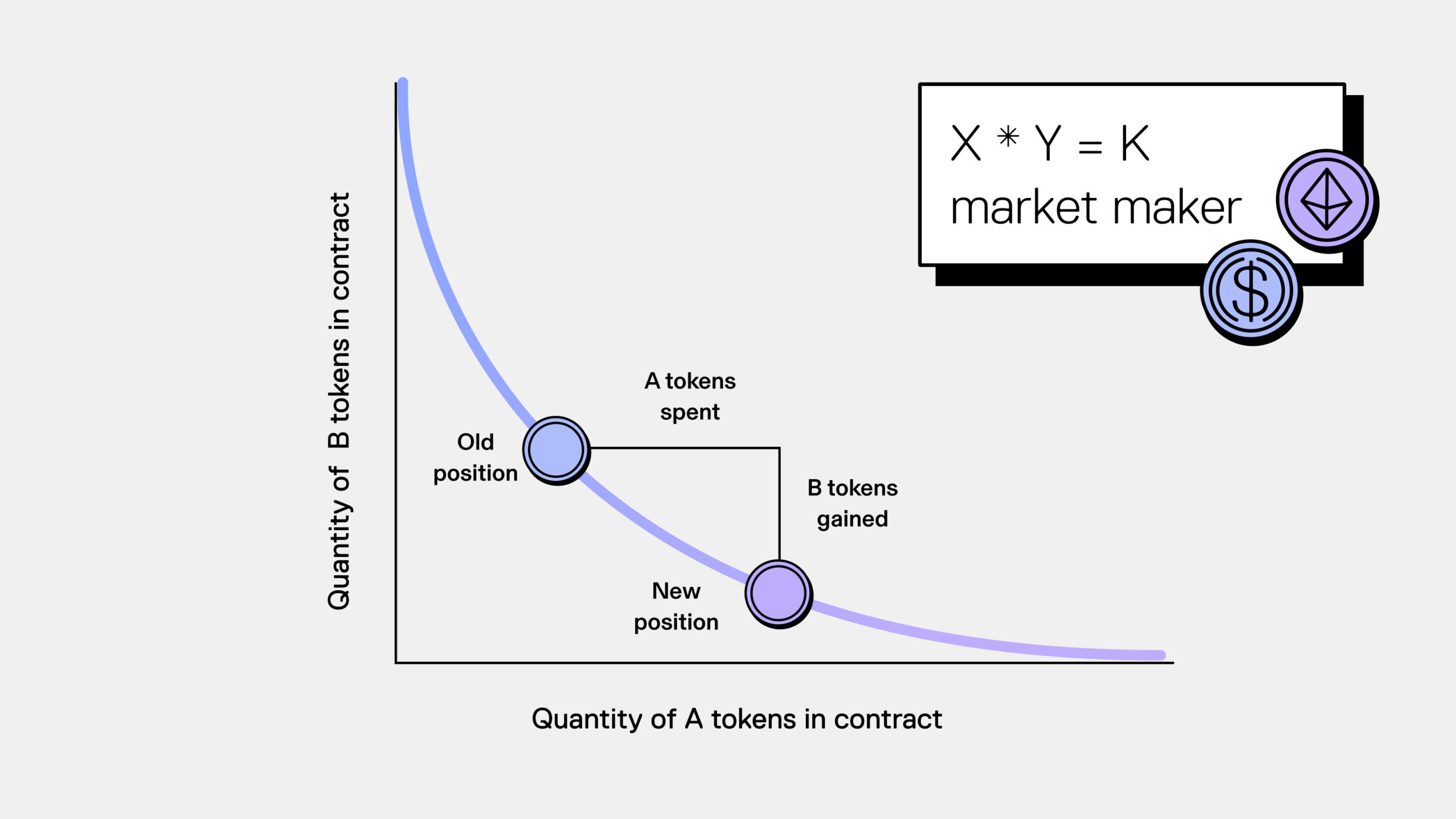
The core pricing formula is X · Y = K. The product of the two asset quantities in the pool must remain constant. The more you buy, the higher the price per token — slippage is not an edge case, it is the mechanism itself.
Pros
- Permissionless (anyone can list any token)
- Always quotes a price (quote quality depends on liquidity)
- LPs earn passive yield
- Fully on-chain and non-custodial
Cons
- Slippage is structural (larger order = worse price, always)
- MEV and sandwich attacks (trade visible in mempool before execution)*
- Impermanent loss for LPs
- Arbitrageurs constantly drain LPs to keep prices accurate
- Liquidity is mercenary (LPs leave when incentives dry up)
*MEV (Maximal Extractable Value) and sandwich attacks deserve particular attention. When you submit a swap, your transaction sits in the public mempool before it executes. MEV bots monitor this queue and insert trades ahead of yours — buying before your buy, selling into your execution, and pocketing the difference at your expense. This extraction happens at scale and is a persistent, invisible cost for AMM traders.
What is Request for Quote (RFQ)?
Request for Quote (RFQ) is a liquidity mechanism that works like a blind auction. Instead of hitting an order book or swapping against a pool, the trader specifies an asset and size and requests prices from multiple market makers directly. Those market makers compete to offer the best price — without seeing each other’s quotes.
The best offer wins. Price is locked at the moment of acceptance — no slippage, no frontrunning, and full order size filled. RFQ is used by Ostium, Hashflow, Paradigm, CoW Protocol, and 1inch Fusion, among others. It is primarily used by larger traders and institutions, though on-chain RFQ protocols are beginning to bring this mechanic to a wider audience.
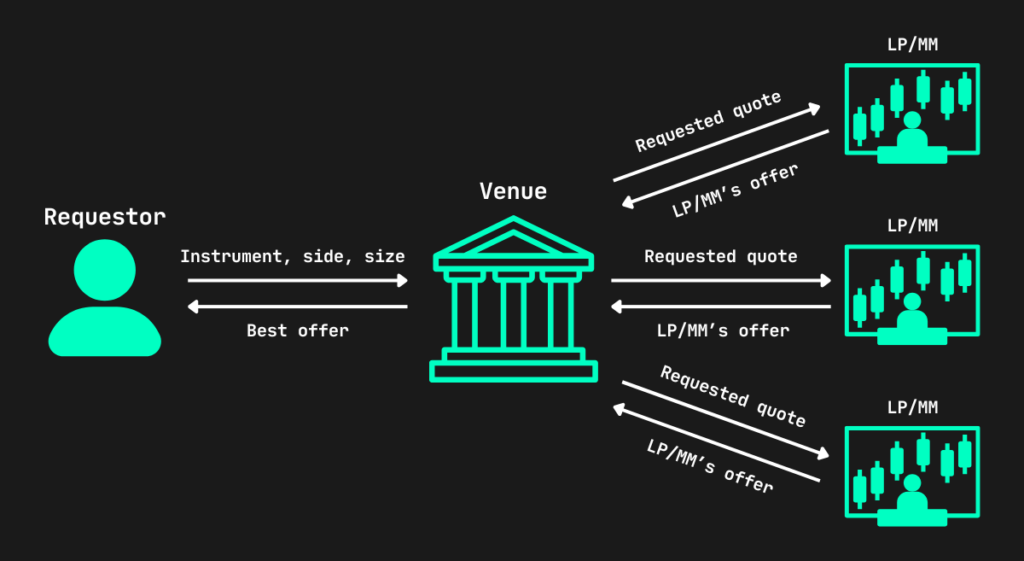
On-chain RFQ is still early but growing fast. Protocols like CoW Protocol and 1inch Fusion run competitive quote auctions on-chain, giving retail traders access to a mechanism previously reserved for institutional block trading.
Pros
- Locked price — no slippage, no frontrunning, full size filled
- Tight spreads due to blind competition
- Capital efficient for MMs (capital deployed on demand only)
- Private quotes (no information leakage before execution)
- Works for complex and illiquid assets
Cons
- Requires multiple active MMs (no quotes = trade dies)
- Less transparent (no public price discovery, harder to audit fair price)
- Short quote lifespan
- Worse price during market stress (MMs widen spreads or go silent)
- Counterparty risk (maker solvency)
- Not suitable for small trades
- Limited retail access
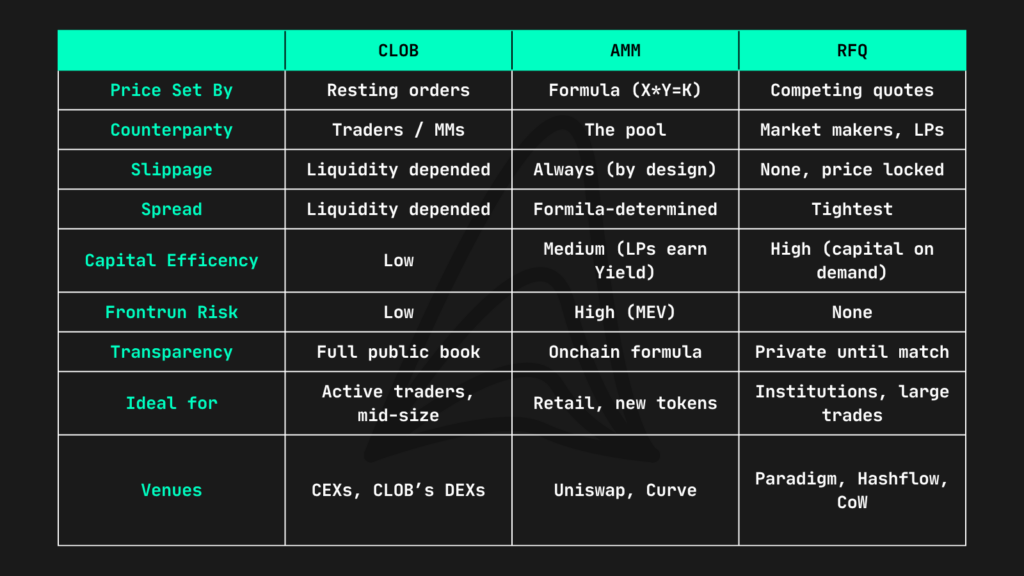
CLOB vs AMM vs RFQ: Side-by-Side Comparison
Which Liquidity Mechanism Should You Use?
CLOB, AMM, and RFQ are three different answers to the same question: how do you match buyers and sellers efficiently? Each has tradeoffs. Each serves a different type of trader.
The CLOB is best for active traders who want transparency and control in liquid markets.
The AMM is best for retail traders and long-tail tokens where permissionless liquidity matters more than execution quality.
RFQ is best for large or complex trades where price certainty and full fill are the priority.
The mechanism is never neutral. It determines who profits from your trade and who pays for the infrastructure. Understanding which model you are trading within is the first step to understanding where your execution costs are actually coming from.
Disclaimer: The information provided in this article is for informational purposes only and does not constitute financial, investment, or other professional advice. All opinions expressed herein are solely those of the author and do not represent the views or opinions of any entity with which the author may be associated. Investing in financial markets involves risk, including the potential loss of principal. Readers should perform their own research and consult with a licensed financial advisor before making any investment decisions. Past performance is not indicative of future results.

Jakob Brezigar
Jakob, an experienced specialist in the field of cryptocurrency market making, boasts an extensive international presence. With Orcabay, he has skillfully managed major operations and deals for a wide array of global stakeholders.