

- Sebastjan Bele
- Updated: March 19, 2026
- Reading time: 6 min
Bitcoin Falls 5% as Rates Hold, Tension in the Middle East Continues & S&P 500 Moves Onchain
The Federal Reserve kept its benchmark rate unchanged at 3.5%–3.75%, reinforcing a cautious stance as inflation pressures persist and rate cuts remain uncertain. Risk assets reacted negatively, with the crypto market losing over $100 billion in value within 24 hours. Bitcoin ($BTC) is holding near $70,000, while crude oil remains elevated around $119, reflecting continued geopolitical and inflationary pressure across markets.
On the industry side, momentum around tokenized assets continues to accelerate. S&P Dow Jones Indices licensed the S&P 500 to Trade[XYZ] for perpetual trading on Hyperliquid, while Hyperliquid’s HIP-3 markets reached $1.43 billion in open interest, driven by 24/7 access to tokenized equities and commodities. The SEC approved a Nasdaq pilot for tokenized equities trading, Flow Traders entered the space with a 24/7 OTC desk, and GSR expanded into token lifecycle management through a $57 million acquisition of Autonomous and Architech.
FTX is set to repay $2.2 billion to creditors this month, potentially reintroducing liquidity into the market, while Kraken has paused its IPO plans amid challenging market conditions. At the same time, Mastercard continues to deepen its exposure to digital assets, announcing the $1.8 billion acquisition of stablecoin startup BVNK, signaling ongoing institutional conviction in crypto enabled payment infrastructure.
News
Table of Contents
Markets
Best Performers
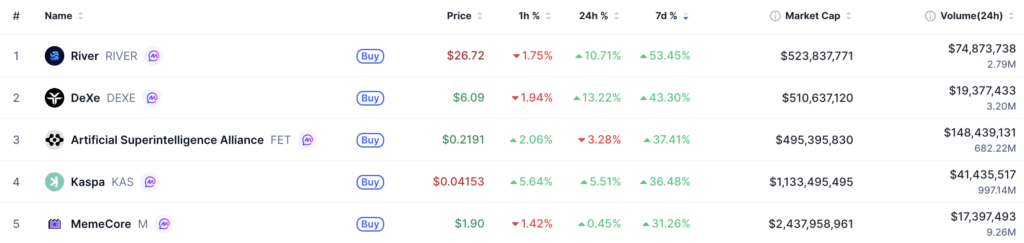
River ($RIVER) led the group with a strong +53.45% weekly gain, continuing its momentum from the previous week. DeXe ($DEXE) followed with a +43.30%increase, as demand for improved DAO governance frameworks remains a consistent theme.
Artificial Superintelligence Alliance ($FET) advanced +37.41%, benefiting from renewed interest in AI related tokens across the market. Kaspa ($KAS) posted a +36.48% weekly rise, extending its steady upward trend amid continued attention on high throughput L1 narratives. MemeCore ($M) rounded out the top five with a +31.26% gain.
Sector Performance
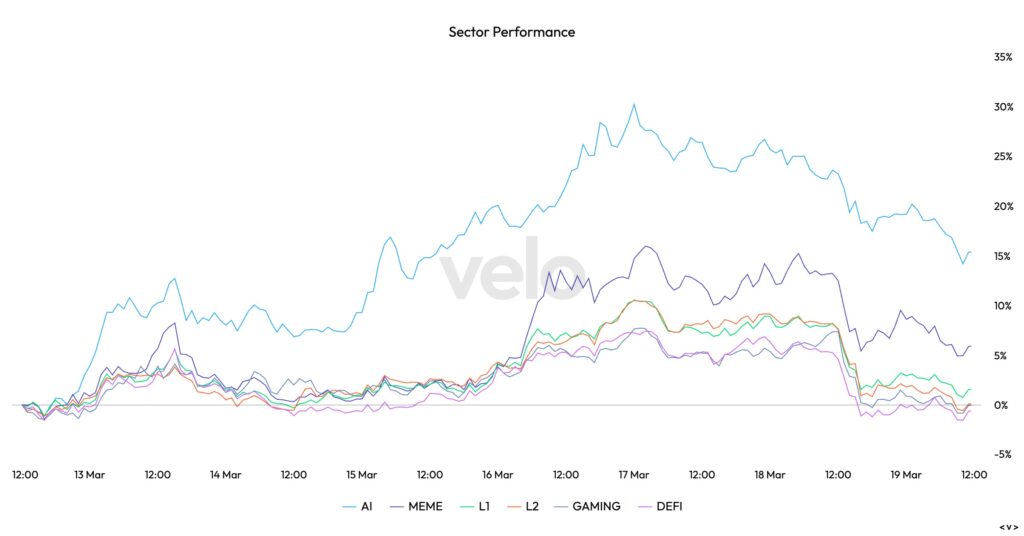
According to GMCI, the GMCI 30, which tracks the top 30 cryptocurrencies, is up 3.13% over the past week. The GMCI Mid Cap is up 2.58%, while GMCI Small Cap is more or less the same, with 0.02% gains. The rest of the sectors:
- Layer 1: +3.49
- Layer 2: +0.99%
- DeFi: +0.44%
- AI: +12.63%
- Gaming: –0.10%
- Meme: +3.63%
US Spot ETF Balances
US Bitcoin Spot ETFs
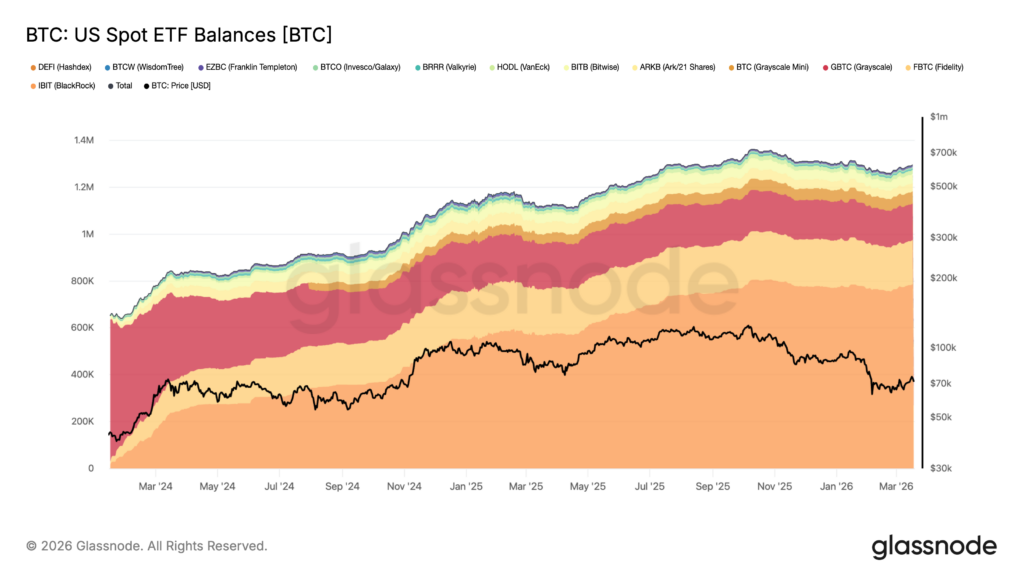
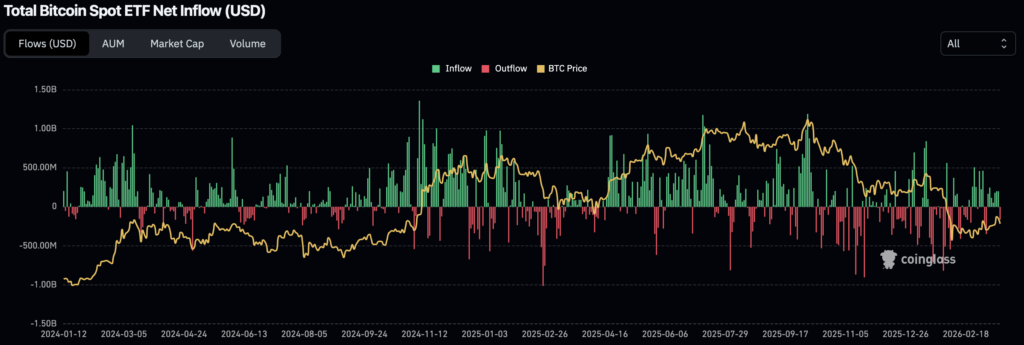
Total Assets Under Management (AUM) = $97.60 Billion
Weekly Inflows = $1.99 Billion
US Ethereum Spot ETFs
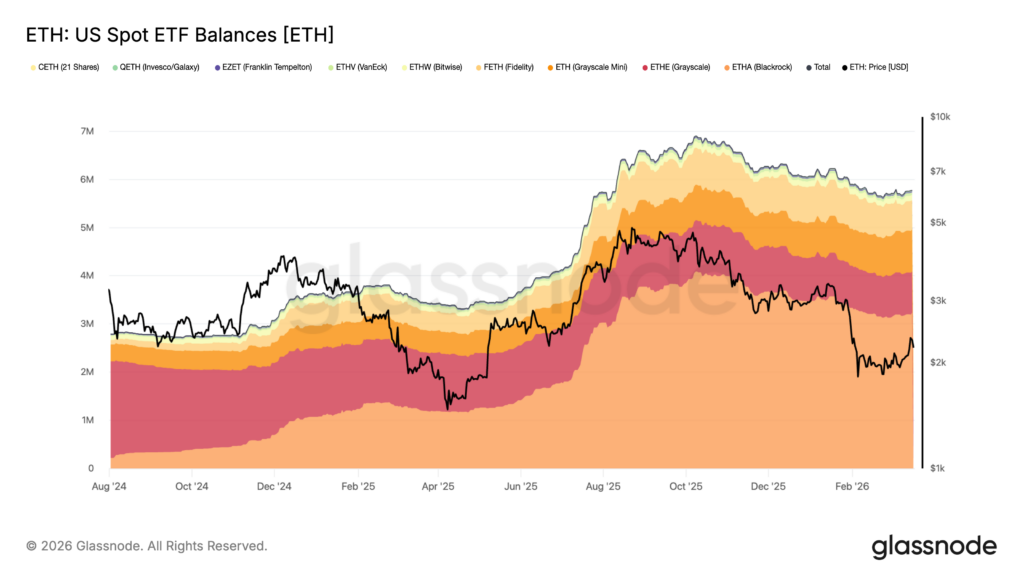
Total Assets Under Management (AUM) = $13.67 Billion
Weekly Inflows = $190 Million
*The data for BTC / ETH ETFs can vary, so we use Coinglass as our source.
Market Commentary
Bitcoin
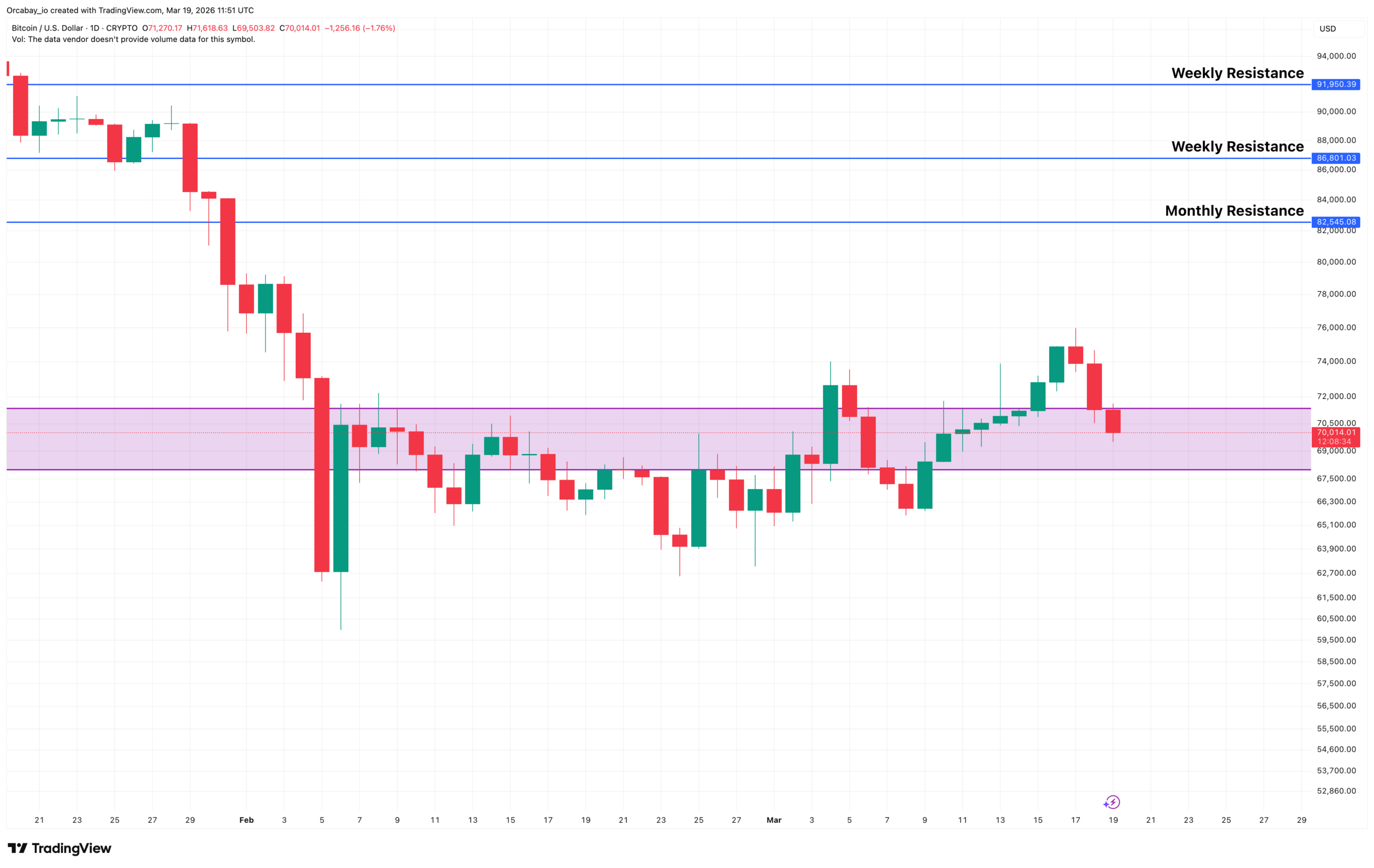
$BTC briefly pushed to $76K, but following hawkish Fed commentary retraced back toward $70K, showing how sensitive the market still is to macro.
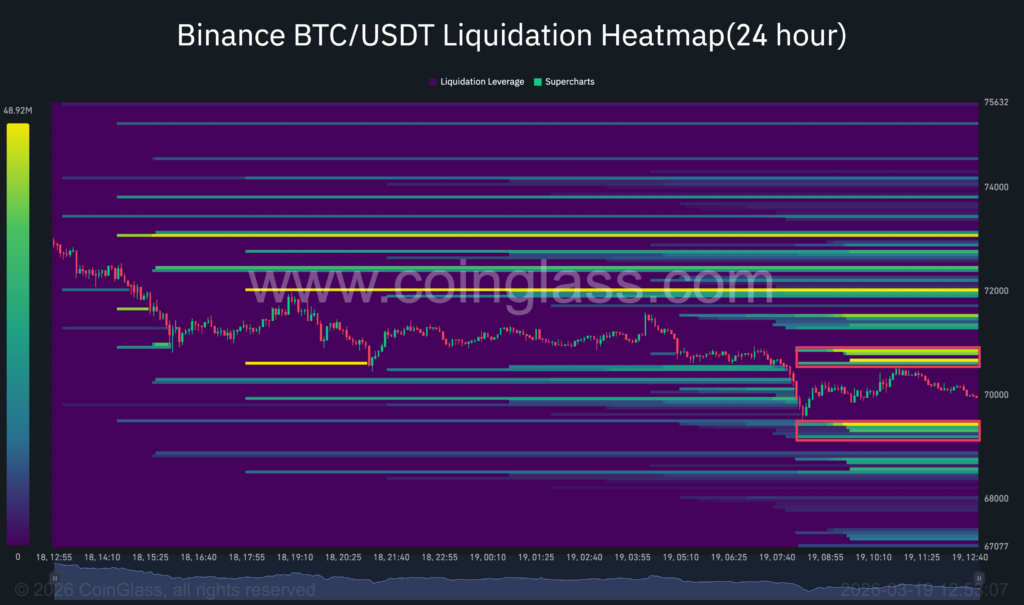
From a positioning standpoint, CVD had been strongly positive, especially on Binance, signaling aggressive market buying into the move. However, the recent pullback shows that demand was not strong enough to sustain higher levels once macro pressure hit.
Open interest remains relatively contained, suggesting this was not an overly crowded leveraged push, but rather a mix of spot and moderate positioning. At the same time, the Coinbase Premium has started to recover toward positive, hinting that U.S. spot demand is slowly returning.
From a price action perspective, the key level remains clear: a weekly close above $72K would signal strength and continuation, while failure to reclaim it keeps BTC in a broader range and vulnerable to further chop.
Ethereum
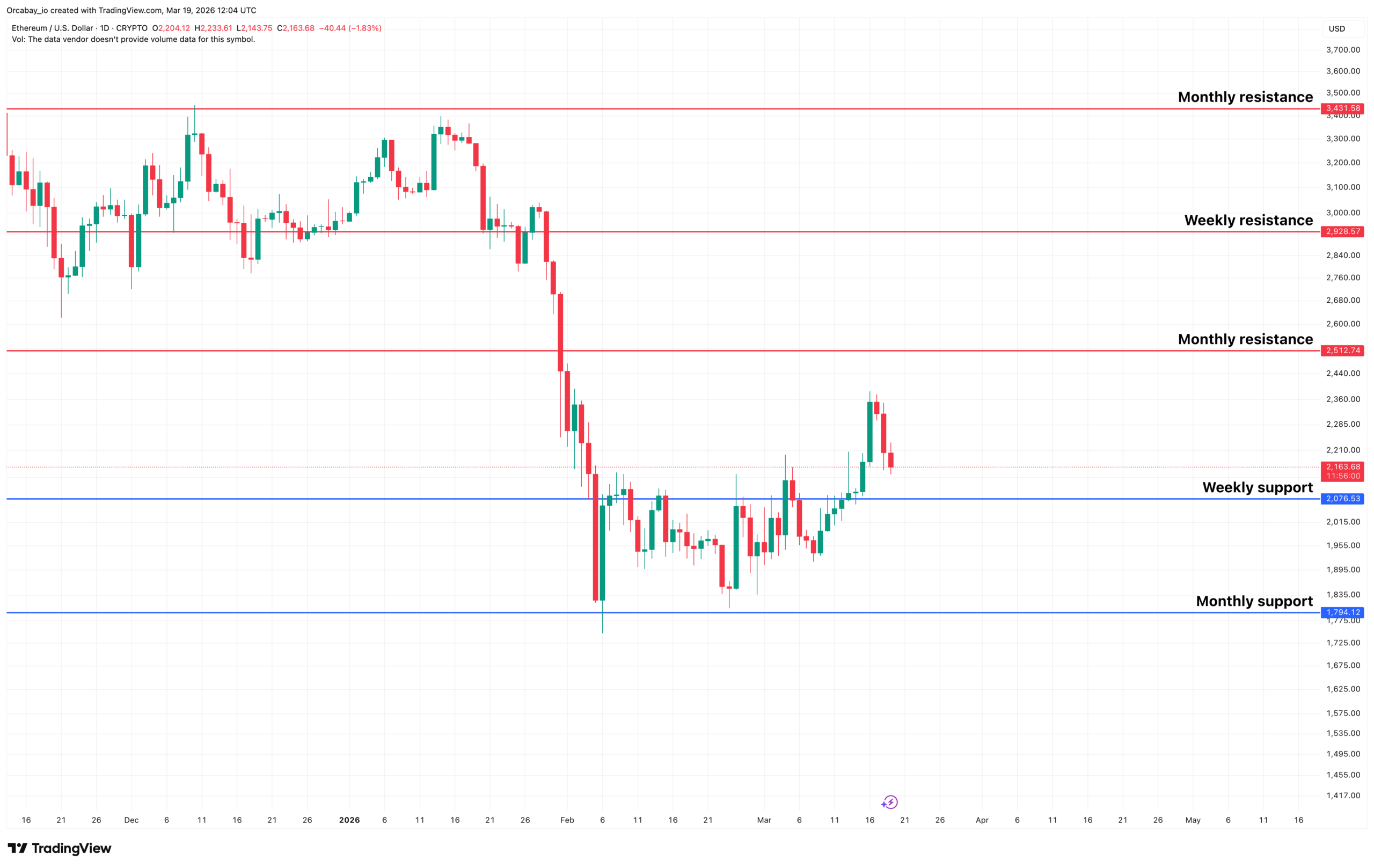
Ethereum is stuck between key levels, with weekly support around $2,000 and monthly resistance near $2,500, keeping price in a broader range.
From a positioning perspective, open interest has been trending higher, meaning new positions are gradually building even as price struggles to break higher. At the same time, CVD remains elevated but has started to flatten, suggesting that the earlier aggressive buying is slowing down.
This creates a mixed structure; positioning is building, but momentum is not accelerating.
For continuation, confirmation of $2,000 as support is key. A clean hold and higher low structure would strengthen the case for a move toward $2,500. Until then, ETH remains in range conditions with risk of chop and fakeouts.
Bitcoin dominance increase to 58.1% (-0.8% weekly).
In traditional markets:
- S&P 500: -0.71%
- NASDAQ: -0.43%
- Gold: -8.71%
- Silver: -16.70%
The total crypto market cap stands at $2.41 trillion, down –2.04% from $2.46 trillion. The Fear & Greed Index is up to 23 (Extreme Fear), from last week’s 15 (Extreme Fear).
What's Next?
The Commodities Dislocation and Policy Paralysis
The global macroeconomic framework is navigating a severe dislocation in commodity markets driven by escalating kinetic conflict in the Middle East. Following strikes on Qatar’s Ras Laffan, which accounts for approximately 20 percent of global liquefied natural gas supply, energy markets are exhibiting extreme regional divergence. Brent crude has surged to $119 per barrel, while Oman crude crossed $154 per barrel. Conversely, West Texas Intermediate trades near $93, with this exploding spread actively pricing in the probability of a United States oil export ban. This dynamic threatens to landlock domestic supply while sending global benchmarks soaring.
This inflationary impulse is cementing a stagflationary reality. Core PCE inflation printed at 3.1 percent annualized, colliding with a softening labor market that saw a 92,000 contraction in payrolls and an unemployment rate rising to 4.4 percent. Consequently, the Federal Reserve has officially halted interest rate cuts for the second consecutive meeting, revising its 2026 inflation forecast higher to 2.7 percent and projecting only a single rate cut for the entire year. With a dense slate of central bank meetings ahead, the market is rapidly digesting a structurally hawkish policy regime.
Structural Decoupling and Institutional Absorption
Despite these immense macroeconomic headwinds, the digital asset class is exhibiting a profound structural decoupling. Bitcoin is holding its post conflict range near $74,000, demonstrating relative resilience by outperforming all major asset classes except oil. The underlying market structure indicates a definitive clearing of early bear market selling pressure. The Coinbase premium has logged 25 consecutive days in positive territory, removing a key structural overhang and signaling sustained institutional bid absorption. This is corroborated by a seven day inflow streak into spot exchange traded funds capturing over $734 million.
Derivatives data points to compression and building leverage. Open interest is climbing back near 88,000 BTC. Crucially, a large pocket of negative gamma sits near the $75,000 strike. Because market makers appear structurally short calls at this level, any spot approach toward $75,000 will likely trigger intense hedging flows, mechanically amplifying upside price momentum. Furthermore, foundational liquidity is returning, highlighted by Binance recording a $2.2 billion Tether inflow, the largest single day stablecoin injection since November 2025. This capital formation is heavily supported by emerging regulatory clarity, as new agency frameworks officially classify major assets like Bitcoin and Ethereum as digital commodities, providing a much needed safe harbor for institutional adoption.
Cross Asset Liquidation and Credit Fractures
Traditional risk assets are rapidly repricing the hawkish monetary reality and the threat of prolonged supply constraints. The Dow Jones Industrial Average fell nearly 800 points, posting its lowest close of 2026. Conventional safe haven assets are also experiencing severe distress. Gold dropped below $4,700 per ounce and silver fell below $70 per ounce. This precious metals contraction is being driven by institutional liquidation and widespread margin calls, as Wall Street engages in net selling to rebalance portfolios in response to rising inflation and the pricing out of rate cuts.
Underneath the equity surface, systemic credit stress is materializing. Market intelligence firms warn that the explosive growth in private credit could become the next major fault line. This risk is already surfacing in the United Kingdom, where the owner of a failed private lender was recently hit with a worldwide asset freeze. However, traditional institutions are aggressively bridging into decentralized rails to find efficiencies. United States banks recently launched the Cari Network to bring FDIC eligible tokenized deposits directly on chain, and Moody’s has initiated independent credit analysis for blockchain financial infrastructure.
The Terminal Volatility Regime
The global market is formally transitioning into a structurally driven regime dictated by persistent supply constraints, sticky inflation, and geopolitical fragmentation. The Federal Reserve is trapped in an impossible position where it cannot ease conditions to support a softening labor market without accelerating inflation.
In this environment, digital assets are absorbing institutional capital as a premier hard asset. Because Bitcoin was already structurally oversold prior to the Middle East escalation, it screened as cheap relative to overleveraged conventional stores of value like gold. Until the physical disruptions in global supply chains are resolved or the overhead liquidity walls near $75,000 are decisively cleared, participants should expect traditional equities to remain vulnerable while decentralized infrastructure commands an increasing premium for its immunity to sovereign supply constraints.
Meme of the Week
We hope you enjoyed this week’s edition of Diary of a Market Maker! Stay tuned for more insights, updates, and market-moving highlights as we continue to keep you informed and entertained in the ever-evolving world of crypto.
In the meantime, follow us on LinkedIn and X (Twitter) for real-time updates and more!
Until next time, happy trading and stay ahead of the curve!
Disclaimer: The information provided in this article is for informational purposes only and does not constitute financial, investment, or other professional advice. All opinions expressed herein are solely those of the author and do not represent the views or opinions of any entity with which the author may be associated. Investing in financial markets involves risk, including the potential loss of principal. Readers should perform their own research and consult with a licensed financial advisor before making any investment decisions. Past performance is not indicative of future results.

Jakob Brezigar
Jakob, an experienced specialist in the field of cryptocurrency market making, boasts an extensive international presence. With Orcabay, he has skillfully managed major operations and deals for a wide array of global stakeholders.